
The old way
The traditional type of swim-sink separation
Swin-sink separation
the conventional method is described here – the „old way“
The enormous variety of plastics is useful. It means that plastics can be used in a myriad of different ways. At the same time, however, it also means that the recycling of plastics is not that easy. Because materially recycled, i.e. directly reused, should only be single-origin or at most slightly contaminated substances. The sink-swim process is a simple method of separating substances that is very efficient, for example, when recycling plastics.
In industry, swim-sink separation is one of the most frequently used separation processes for plastics. The sink-swim process is a very simple process that can be used to separate two solids. However, this process only works if the two substances to be separated have different densities. In addition to the use of water, however, defined liquids can also be used.
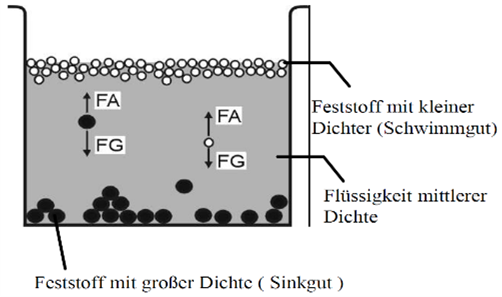
A mixture to be sorted, the density of which differs from one another (PE, PP, PA, PC, PVC etc.) is poured or stirred into a separating liquid, usually water, with a density of 1 g / cm³ from above. The specifically lighter material to be separated below density 1 will consequently float up, the specifically heavier one will sink. All of this takes time. The separation medium water is preferably used. If other densities are required, the density of the separating medium is adjusted by adding substances, the action of which directs the water in the desired directions. Alcohols or salts are known as starting materials here. However, they can also be defined basic liquids.
The result is two fractions: firstly, floating debris, that is, solids of lower density, and second, sinking debris, that is, solids of greater density.
User systems of this method are characterized in part by treatment basins that are huge in terms of volume. The process definition „sinking speed = basin and system length“ and the influence of an economically necessary amount by the „basin width = volume throughput“ result in large-volume containers with limited efficiency and low throughput. This means: goods to be separated require long distances to separate = sink (from 3,000 cm) and plenty of inlet across the width (from 1,000 cm) of a container.